INTRO CULTURAL ANTH ANTH212 SEC 700 Spring 2022
Anthropology 212:
Introduction to Cultural Anthropology
Contact Information
Instructor: Raymond Hames
Department of Anthropology
Office: 837 Oldfather Hall
Office Phone: 472-2420
Email: rhames@unl.edu
Virtual Office Hours: every Monday 9:00 AM and Thursday 9:00 AM. Scroll down on the left side and click Zoom for meeting details
My personal meeting id/link is https://unl.zoom.us/j/4128454993 for regular office hours or by appointment meetings for those who can't make regular Zoom office hours.
Click below to learn a bit about my background and advice on how to succeed in this course:
This course is basic introduction to the field of cultural anthropology. The main text (see image at the top of the page) for the course will be the 10th edition of Cultural Anthropology: A Global Perspective by Raymond Scupin (ISBN: 9781544363141 for paperback). You can purchase this book on-line through UNL's Campus Store. However, you are likely to find better deals at Barnes&Noble; Textbooks.com; Amazon.com; CheapestTextbooks; etc. even though they may not have buy-back policies like the Campus Store.
Your textbook is clearly and engagingly written and is strongly comparative in nature. By that I mean topics such as marriage, kinship, economic systems, sexual practices and the like are presented in their full range of cultural diversity. While there are longer and more detailed texts available they tend to read like encyclopedias merging the esoteric and rare with the common and significant. The strength of the Scupin's text is its focus on core cultural anthropological issues from a variety of scientific views through a consistent cross-cultural perspective.
In addition, your textbook has a excellent set of on-line aids whether your purchase hard or electronic versions. It is superior to the previous text for this course. These resources include sample tests, flashcards, and video and other multimedia aids. Sample Tests and Flashcards will be helpful for test preparation, so use them. They are found at https://edge.sagepub.com/scupincultural10e. I will provide links to a few of those video as appropriate for some chapters. You do not need to view any of the supplementary materials at the Sage Site I don't explicitly link, unless of course you find some compelling.
In addition to the textbook there are a number of on-line readings and videos. Many of the on-line readings are from reliable news publications or science orientated magazines describing recent research in anthropology of great interest such as the trends in inequality, sex and gender issues, and globalization. These readings will help you keep abreast of the dynamic nature of anthropology and its relevance to the general public. You will also view a number of videos to provide you with a humanistic portrayal of a range of societies especially from the view-point of individuals in different cultural groups. Reading and viewing guides usually accompany the articles and films to guide your understanding of theses media. In all cases, some exam questions will be taken from these sources.
ACE Course
This is an ACE certified course for SLO #6 which revolves around the "Use [of] knowledge, theories, methods, and historical perspectives appropriate to the social sciences to understand and evaluate human behavior." A critical means to evaluate this learning outcome will be determined in your book report in which you will demonstrate your understanding of cultural diversity in social life and some of the theories that help us understand this diversity.
Assessment. In the assessment of this course by the Department of Anthropology and College of Arts and Sciences, a sample of exams and course projects will be reviewed while maintaining student anonymity.
New to Canvas? For those of you who are new to Canvas or would like a refresher on how on-line courses work, please click here for a "Canvas Student Orientation"
Tips for Educational Success in an on-line world:
The above link deals with Student Resources, Academic Integrity, and Learning in an on-line world
Exams: All exams will be taken through UNL's Digital Learning Center (DLC) Exam Commons or through Respondus Lockdown. Use this link to schedule an exam at the DLC. To install Respondus Lockdown use this UNL mediated Respondus link. For detailed information and installation instructions, use this link.
My lectures, in the form of narrated PowerPoint presentations, will review and expound on text book topics as they occur in each of the chapters and sometimes focus on some of the most recent findings on cultural diversity and relevant theory that attempts to account for cultural variation in human behavior.
Accessibility Statement
Students with disabilities are encouraged to contact the instructor for a confidential discussion of their individual needs for academic accommodation. It is the policy of the University of Nebraska-Lincoln to provide flexible and individualized accommodation to students with documented disabilities that may affect their ability to participate in course activities fully or to meet course requirements. To receive accommodation services, students must be registered with the Services for Students with Disabilities (SSD) office, 132 Canfield Administration, 472-3787 voice or TTY.
Grading Basics
There will be four exams worth 40 points each (for test dates, see course schedule below) and will consist of 40 multiple choice questions. The book report is worth 75 points. For details on the book reports format and due dates, scroll down to "Book Report Instructions for an Ethnography of Your Choice" below the weekly schedule table.
Finally, there are no extra credit options for the course. If you begin poorly but continue to improve subsequently I will give you the benefit of your improvement.
Failure to take an exam or turn in a book report on the day assigned will result in 0 grade. Only a documented illness, family emergency, or some extreme extenuating circumstance (e.g., incarceration) will persuade me to give you a make-up exam or to extend the book report due date. By documented I mean an official note from a doctor, family member, or some other reasonable source.
Grading Details. This course is structured into four modules which follow the chapters in our text. Grades will be based on four exams and a book report for a maximum of 220 points and will be awarded as follows:
- 40 point Exam 1 Feb 10-12
- 40 point Exam 2 Mar 23-25
- 40 point Exam 3 Apr 20-22
- 5 point approval of ethnography 10 April
- 75 point Book Report 30 April
- 40 point Exam 4 May 10-12
TEACHING SURVEY
Your instructor is participating in an inquiry into his/her/their teaching conducted by Dr. Taylor Livingston and Dr. Ibrahimpasic, colleagues in the School of Global Integrative Studies. They are examining the effectiveness of instructional strategies, comparing, and/or evaluating the effectiveness of instructional techniques, curricula, or classroom management methods. You are encouraged to participate in anonymous, voluntary surveys administrated at two time points during the semester (One Month and End of Semester). Your responses are very useful to demonstrate the success of various teaching methods and strategies. You may also be asked to meet with your professor. No data will be collected at this meeting. Your participation in this inquiry is voluntary, does not affect your grade for this course, and there is no compensation should you choose to participate. Your participation should total no more than 30 minutes of outside class time over the course of the semester. A consent form will be distributed via Qualtrics in the first survey.
In regards to the voluntary survey, you will receive emails from me on behalf of Drs. Livingston and Ibrahimpasic with a link to an informed consent form in Qualtrics, as well as invitations to take anonymous surveys administrated at two time points during the semester (One Month and End of Semester). Your responses are very useful to demonstrate the success of various teaching methods and strategies. As noted above, your participation in this inquiry is voluntary, does not affect your grade in this course, and there is no compensation should you choose to participate. Your participation should total no more than 30 minutes of outside class time over the course of the semester. Let me know if you have any questions about the project.
Course Schedule: Introduction to Cultural Anthropology
(Anthropology 212)
Spring 2022
|
Week & Date |
Topic |
Text Book Readings |
Web Reading Assignments and/or Video Reports |
Exam or due dates |
|
Module 1 (Chapters 1-4) |
||||
|
Introduction to Anthropology and Evolution |
Chap 1 |
Video: A Man Called Bee |
|
|
|
Human Evolution |
Chap 2 |
|
||
|
Culture |
Chap 3 |
|
|
|
|
Psychological Anthropology |
Chap 4 |
|
First Exam: Feb 10-12 |
|
|
Module 2 (Chapters 5-9) |
||||
| Language |
Chap 5 |
|
||
| Explanation |
Chap 6 |
|
||
|
Sociocultural Systems |
Chap 7 |
|
||
|
8 Spring Break |
|
|
|
|
|
Environment, Technology, Food Production, & Economics |
Chap 8 & 9 |
Web reading: “Garden of Eden?” Video: Bitter Melons |
Second exam Mar 23-25 |
|
|
Module 3 (Chapters 10-13) |
||||
|
Family & Marriage |
Chap 10 |
|
|
|
| 11 Apr 4
|
Sex & Gender |
Chap 11 |
Video: Some Women of Marrakesh |
|
|
Politics & War |
Chap 12 |
Book report selection approval | ||
|
Religion & Aesthetics |
Chap 13 |
|
Third Exam Apr 20-22 | |
|
Module 4 (Chapters 14-17) |
||||
|
Globalization, Indigenous Societies, & Colonization |
Chap 14-15 |
|
Book report due Apr 30 | |
| Race & Ethnicity | Chap 16 |
|
||
| Applied Anthropology | Chap 17 |
Fourth Exam May 10-12 |
||
Book Report Instructions for an Ethnography of your Choice


You are required to write a seven to nine page (about 315 words per page for a total of 2205 to 2835 words) book report on an ethnography of your choice that has been approved by me. For approval, go to Assignments and click on "Book Report Approval. Enter the author and title of your desired ethnography by 10 April. (Please note you can make your selection during the second week of the course.) I will decide whether the ethnography is suitable. If it is, I will give you five points. If not, will ask you to submit another.
An ethnography is a systematic or holistic account of a particular people or culture usually written by an anthropologist and based on living with and observing a particular cultural group. Sometimes an ethnography can be highly focused on a sub-cultural group (migrants, ethnic groups in a multi-cultural society) or on special topics such as religion, crime, health, warfare, etc. If for some reason you decide don't like the ethnography, you may change it at any time so long as you inform me and go through a new approval process.
Thousands of ethnographies have been written so you should have considerable latitude in choosing one that suits your interests. If you have a problem selecting an ethnography on a particular topic or area of the world, visit me and I will see what I can do to assist you. Use the links below for lists of ethnographies.
To help you gain an idea of what I consider to be an excellent book report, copies of previous book reports for this class are electronically available. To view these reports, scroll down to "Model Book Reports" below and click on the link.
Do not use long quotes, quotes longer than two lines. The goal is to express your understanding of the ethnography.
The book report will count 26% of your total class grade and is due the day indicated on the course syllabus. If you wish, you may turn in a rough (but readable and complete) first draft on or before 20 April for my comments and a preliminary grade. I will return your draft with my comments to you by 23 April. You then have the option of changing the report or resubmitting it unchanged on 30 April, the day the book report is due. Please send first and final drafts to me at rhames@unl.edu as an email attachment and format the report in MS Word or RTF. Please do not use "Google Drive" or other cloud-based service. Finally, please name your file "last name-book-report" (e.g., Jones-212-Book-Report), or something similar that contains your name.
Format:
In general, the report should follow the outline described below. Be aware that this is an all purpose outline and it may be impossible or difficult to answer some of the outlined questions. For example, in older ethnographies ethnographers don't describe their methods. In such a case, simply state that the ethnographer did not describe his or her methods, and move on to the next topic.
I. Introduction: a clear statement of the central theme, focus, issue, or problem the ethnographer investigated.
II. Methods: describe the methods the ethnographer used to collect data (e.g., interview, participant-observation) and the techniques (e.g., statistical, case study) used to analyze the data.:
III. Body of paper (about two-thirds of the report):
A. Provide a chapter-by-chapter survey of the contents of the ethnography and evaluate how well it supports the stated goal(s) of the ethnography.
B. Be sure to Discuss important issues of the ethnography and attempt to relate them (whenever possible) to what you have learned from the lectures, videos, or assigned texts and web readings.
IV. Discussion and Conclusion:
A. What is the theoretical perspective of the ethnographer and how does it color his or her analysis of the data?
B. Is the ethnographer convincing, that is, are the methods and data adequate for dealing with the research problems?
C. Does the author attempt to generalize the findings through use of the comparative method?
D. How did the ethnography help you understand more deeply something about your own culture?
E. How did the ethnography reinforce or undermine any of your assumptions about human behavior?
Model Book Reports
Go to the Model Book Report Page to view examples excellent book reports written by former students
Miscellaneous:
- Please review Section 4.2 of UNL's Student Code of Conduct on academic honesty for definitions and warnings about plagiarism and other forms of academic dishonesty. If you plagiarize or cheat in any way, you will receive an F for the course.
- The paper should have a front page containing your name, the course name, book title, and author name.
- Final Note: Failure to take an exam or turn in a book report on the day assigned will result in 0 grade. Only an illness, family emergency, or some dire extenuating circumstance will persuade me to give you a makeup exam (essay format) or to extend the book report due date. Retain a copy of your book report in case the one you wrote or submitted to me disappears.
The following links contain a list of ethnographies many of which have paragraph description of their contents. About 90% of these are acceptable but be sure to have me approve the book before you begin.
- Cenage: once there, click on the link to " cultural anthropology". You will arrive at a variety of book titles that you can click on for further information. (note that some of the books are for general cultural anthropology that you should bypass.)
- Waveland Press Web Site , once there click on "Ethnographic Case Studies"
Search Strategies at Love Library
The best way find ethnographies at Love Library is to use a "subject" search. Here is how you can do it. First log-on to love library at http://iris.unl.edu Once there, select "Catalogs" and then "UNL Libraries Catalog". Under "Search catalog by" select "subject". A subject search screen will appear and in it type "social life and customs". The result will be more than 5,00 entries. At this point you can begin to scan through the entries or, more productively, you can use the "limit search" option at the bottom of the page to search within. For example, using the "words in title" option you can add words such as "women" or "Africa" or "Indians" to bring up ethnographies or groups of ethnographies that deal with topics specified.
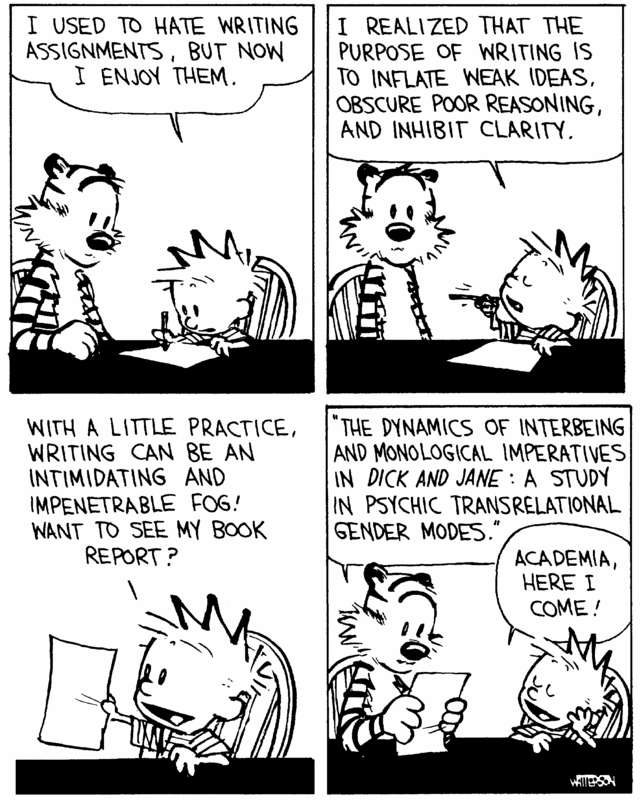
Clarity and directness are prized. Avoid this inspiration:
Course Summary:
| Date | Details | Due |
|---|---|---|